
New Video Reasoning Model Passes 101 Computer Vision Tasks
Pittsburgh, Pennsylvania, United States, Nov. 24, 2026 — Canada & World Report — An international research team led by Hokin Deng at Carnegie Mellon University has introduced Omni-Reason-1, a video reasoning model that passed 101 of 170 computer vision tasks in the team’s tests. In an interview, Deng said the model takes a video and a one-sentence instruction and generates a video response, allowing one system to perform tasks usually handled by separate specialized models.
Before GPT, natural language processing was divided among tasks such as translation, summarization, sentiment analysis and question answering. General-purpose language models brought many of them into a shared framework.
Computer vision remains fragmented across object detection, segmentation, tracking, depth estimation, pose estimation and physical reasoning. Researchers from CMU, UC Berkeley and 20 other institutions, working with the Amazon Trainium team, developed Omni-Reason-1. It brings these tasks into one video reasoning interface, echoing the shift general-purpose models brought to language.
Omni-Reason is an international academic collaboration led by Hokin Deng at Carnegie Mellon University in the United States. Researchers from UC Berkeley, Stanford, Johns Hopkins, Columbia and other universities contribute, primarily from the United States, with collaborators in Singapore, Hong Kong, the United Kingdom and Canada. Engineers from Amazon Web Services (AWS) also took part. Team members work in multiple locations; the project has no single home office.
Show Omni-Reason-1 a sunny driving video and type: “Transform this clear-weather driving video into the corresponding heavy-rain driving video.” It returns the same car and intersection in a downpour, with reflections on the wet road.
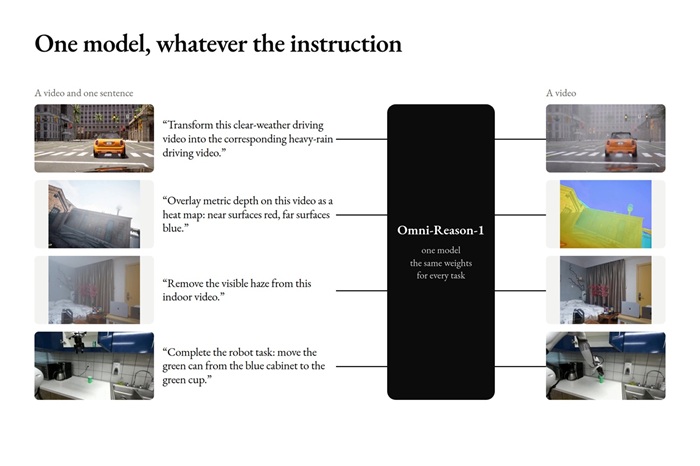
Different instructions, one model solves them all.
In the team’s evaluation, Omni-Reason-1 passed 101 of 170 computer vision tasks. Each is typically handled by a separate, specialized model.
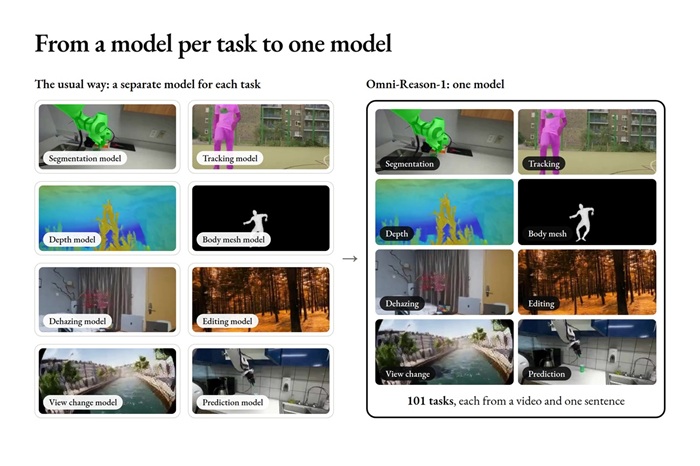
Computer vision tasks are usually handled by separate, purpose-built models. Omni-Reason-1 handles them with one. All frames shown are model outputs.
Change the instruction and the same model performs a different task. Ask it to highlight a robot arm on a cluttered desk, and it colors the robot green. Ask it to remove haze from an indoor video, and the bedroom becomes clear. Ask for metric depth as a heat map, and a brick building is colored according to its distance from the camera.
The idea: reason from video, answer in video. A still image cannot show how things move or change; video can. With a video input, a text instruction and a video output, one model can be trained for many visual tasks. “Language models showed that one system can take on many tasks once they share a form, text in and text out,” said Hokin Deng, who leads the Omni-Reason team. “For vision, we think that form is video.”
Many of the same researchers previously built VBVR (A Very Big Video Reasoning Suite), an open dataset and benchmark published at ICML 2026. Created by 56 researchers from 32 institutions, it covers 200 reasoning tasks and more than a million video clips—roughly 1,000 times the scale of earlier comparable datasets, according to the team.
VBVR was Hugging Face’s No. 1 Paper of the Day and drew over 100 videos, articles and posts on YouTube, LinkedIn, X, WeChat, Bilibili, Douyin and Xiaohongshu without paid promotion. The team’s open resources and community-built VBVR models have exceeded 320,000 Hugging Face downloads, more than 40,000 of them in the most recent 30-day period. Kuaishou’s Kling team has used the benchmark in its research.
Omni-Reason-Data contains 30.66 million paired examples (81 TB) spanning 340 computer vision tasks. Omni-Reason-1 was trained on a subset and passed 101 of 170 evaluated tasks. In the team’s tests, Kling O3 Standard passed 39; Gemini Omni Flash, 33; Seedance 2.5, 29; and Grok Imagine Video, eight. The best of eight open-weight models passed 19.
Tasks passed. † Commercial models were evaluated on one test video per task.
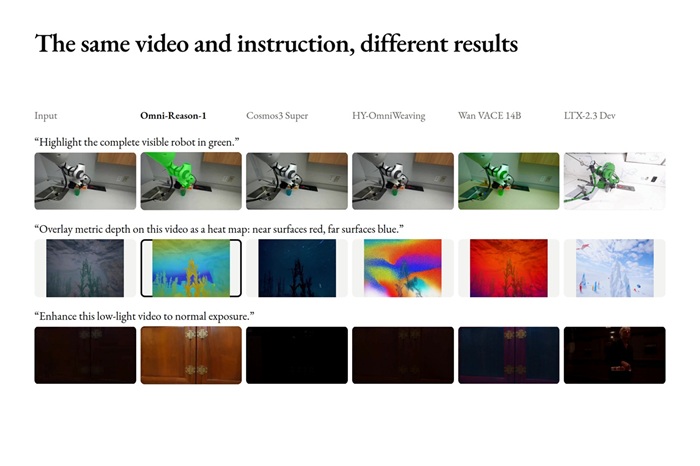
The same tests given to Omni-Reason-1 and four open-weight video models.
Model architecture. Omni-Reason-1 is a video diffusion transformer with about 13 billion parameters. The input video, any reference image or clip, and the answer being generated are converted into tokens and processed as a single sequence. Learned tags identify each token’s role, its input, its frame-by-frame alignment with the answer and its image type. The answer attends to every input, while the inputs do not attend to the unfinished answer. Every task uses the same training objective, without task-specific components.
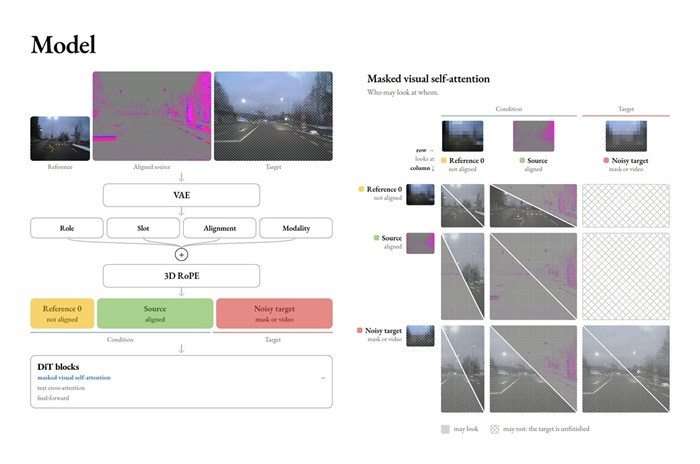
How Omni-Reason-1 reads a request. The reference, source video and unfinished answer become tokens in one transformer.
Built on Amazon Trainium. Omni-Reason-1 was trained on AWS Trainium2 chips. On one EC2 trn2.48xlarge instance, it generated a 97-frame video in 6.6 seconds; one NVIDIA RTX PRO 6000 Blackwell GPU took 38.4 seconds with the same model and settings. In this hardware comparison, the Trainium2 instance was 5.8 times faster. The team reports 17 videos per minute on the instance and an estimated compute cost of $34 per 1,000 videos. It is releasing training and inference code for Trainium.
What is being released. The team has released the model weights, Omni-Reason-Bench (340 tasks), and inference, evaluation and data tools. Omni-Reason-Data follows the terms of its original sources; the team’s code and tools are under Apache 2.0.
About Omni-Reason
Omni-Reason is a research project on general video reasoning models that take video as input and generate video as output. It includes Omni-Reason-1, Omni-Reason-Data and Omni-Reason-Bench. Paper, model, data, benchmark and code: https://omni-reason.com
Media contact:
Steven Zhao
Canada & World Report
zhao@canadanewsreport.com