How Much of Earth’s History Can One Stone Hold? 54th Annual Wonders of the Earth Gem and Mineral Show Coming to Toronto in September
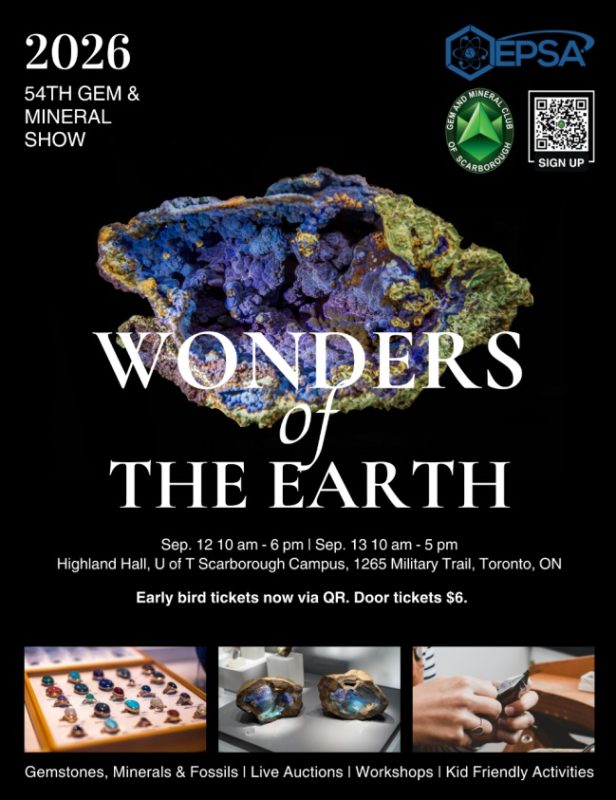
TORONTO, Ontario, Canada, Aug. 29, 2026, Canada & World Report—The 54th annual Wonders of the Earth Gem and Mineral Show will take place at the University of Toronto Scarborough on September 12 and 13, 2026.
Organized by the Gem and Mineral Club of Scarborough (GMCS) and co-hosted by the Environmental and Physical Sciences Students’ Association (EPSA), the show will be held at Highland Hall. According to the organizer’s website, it will run from 10 a.m. to 6 p.m. on Saturday, September 12, and from 10 a.m. to 5 p.m. on Sunday, September 13.
Place an apparently silent stone in the palm of a geologist, and it may no longer appear to be an ordinary rock. Instead, it becomes a page in Earth’s archive, written in crystals, colours, fractures and inclusions. It may record cooling magma, flowing hydrothermal fluids or changing oceans. It may also preserve the outline of a leaf from millions of years ago, the remains of a trilobite or evidence of a journey through space.
In geology, the terms “mineral,” “rock” and “ore” are not interchangeable. A mineral is a naturally occurring inorganic solid with a relatively consistent chemical composition and an ordered internal structure. A rock is generally composed of one or more minerals, while an ore is a naturally occurring material from which economically valuable minerals can be extracted.
Why do some minerals form cubes, hexagonal prisms, plates or needles? The answer lies in structures too small for the human eye to see. Crystals consist of atoms arranged in orderly, repeating patterns. Under suitable growth conditions, this internal order influences the mineral’s external form. Pyrite often develops nearly cubic crystals, while quartz commonly grows as six-sided prisms. Their geometric beauty is not the result of accidental natural carving, but an outward expression of order at the atomic level.
This year’s show will bring together gemstones, minerals and fossils, along with educational talks, live auctions, workshops and activities for children. Visitors will be able not only to admire the colours and forms of the specimens, but also to learn about their origins, chemical compositions, formation environments and geological ages.
The live auction catalogue resembles a miniature geological map of the world. Items include opals from Coober Pedy, Australia; native silver in matrix from Cobalt, Ontario; gypsum desert roses from Chihuahua, Mexico; quartz crystal clusters from Madagascar; and fossilized Paleocene leaves from Montana dating back approximately 60 million years.
Despite its romantic name, a desert rose is neither a flower nor a plant fossil. It is a rose-shaped crystal cluster, commonly formed from gypsum in an arid environment. Native silver, meanwhile, refers to silver occurring naturally in elemental form within its host rock, rather than silver that has already been refined and made into an object.
The appeal of a mineral specimen therefore lies in more than its colour, size or market value. Its origin, formation process and immense age may be just as fascinating as its appearance.
The show will also turn part of Highland Hall into a geology classroom. According to the published speaker schedule, presentations will cover the geological history of southern Ontario, meteorites, sulfur, orange minerals and gemstones, and an introduction to trilobites. A child-friendly presentation titled “Milo and the Midnight Meteorite” is also scheduled.
The talks will explore questions that may sound simple but have surprisingly complex answers: Where did the rocks beneath Toronto come from? How can a meteorite be distinguished from an ordinary terrestrial rock? How were trilobites, which disappeared hundreds of millions of years ago, preserved so clearly in stone? How do chemical elements, crystal structures and trace impurities affect the colours of minerals?
Hands-on workshops will move the experience from observation to creation. Activities will include crystal growing, chainmaille, scale-maille pendant making and bracelet making. Some workshops require advance registration or an additional fee and have limited capacity. The workshop schedule indicates that informal crystal-growing and chainmaille activities will be offered throughout both days.
Event materials also indicate that a gem identification service will be available, with a limit of two items per person. This type of on-site service is generally intended to help visitors understand the likely material and basic characteristics of a specimen. It should not be considered equivalent to a commercial gemological laboratory report or a professional appraisal.
Colour alone is rarely enough to identify a mineral. Crystal form, lustre, streak, hardness, cleavage, density and magnetism may all provide important clues. The same mineral can display different colours because of trace elements, structural defects or inclusions, while two specimens that look nearly identical may have entirely different chemical compositions. The brightest specimen is not necessarily the rarest, and an unremarkable-looking rock may contain scientifically valuable evidence of Earth’s past.
Founded in 1963, the Gem and Mineral Club of Scarborough has long promoted public education and activities related to mineralogy, paleontology, gemology, jewellery making, lapidary arts and field collecting. The club also supports interest groups devoted to minerals, meteorites, gemology and lapidary work, encouraging participants to move beyond simply owning an attractive stone and learn how it formed, how it is classified and what it can reveal.
The show will be held at Highland Hall, University of Toronto Scarborough, 1265 Military Trail, near Ellesmere Road and Morningside Avenue.
Admission at the door is C$6 for adults, while advance adult tickets purchased online through the event’s QR code are C$5. Admission is C$1 for children and teenagers between the ages of five and 17, and free for children under five. University of Toronto Scarborough students may enter free with valid student identification.
Reduced-rate parking vouchers for Parking Lot G will be available at the entrance. Accessible parking is available beside Highland Hall in Parking Lot A. As presentation times, workshops and other program details may still change, visitors are encouraged to consult the Gem and Mineral Club of Scarborough website before attending.
At this show, a stone is no longer simply a stone. It may be the cooled remnant of volcanic activity, a deposit formed beneath an ancient sea, the preserved outline of a vanished form of life or a letter from Earth’s distant past—written over millions of years and only now opened by human hands.