Fang Ting Ting Opens Toronto Solo Exhibition During First Canadian Arts Exchange
TORONTO, Oct. 30, 2026 — Artist and curator Fang Ting Ting began her first arts exchange in Canada on Oct. 29 with a visit to Art Toronto led by Michael Janzen, chairman of the International Federation of Arts & Artists (IFAA), followed by a tour of the Art Gallery of Ontario (AGO).
The visits preceded the Oct. 30 opening of From Here, What Remains, Fang’s solo exhibition organized by the Asian Academy of Arts, where she serves as dean. Her itinerary connected the exhibition with encounters involving Canadian and international galleries, museum collections, artists, and members of Toronto’s cultural and media communities.
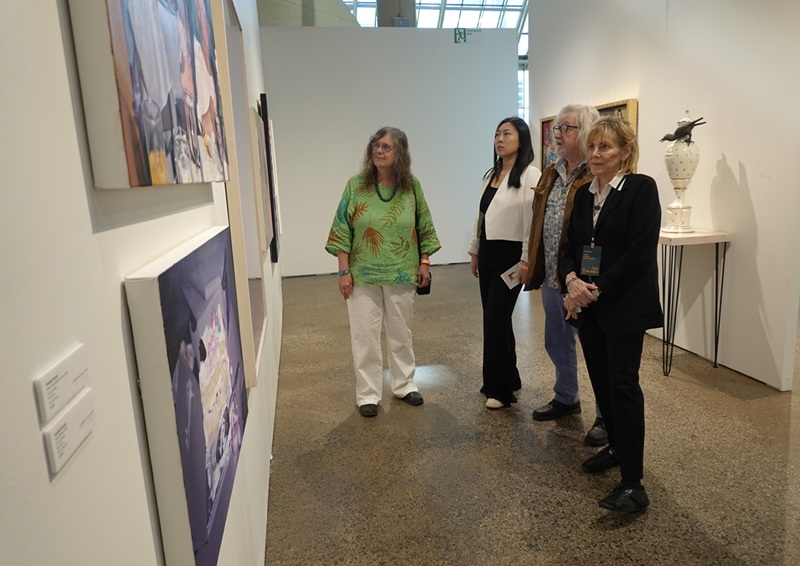
At Art Toronto, a major international art fair held at the Metro Toronto Convention Centre, Fang met gallery owners and arts professionals alongside Janzen and Danielle Marie Nowak, editor of International Arts News.
At the Corkin Gallery booth, the group met owner Jane Corkin and posed for a photograph together. Founded in 1979, Corkin Gallery has presented hundreds of exhibitions across photography, painting, sculpture, installation and other media. Its early focus on photography examined the medium’s relationship with other forms of artistic expression.
The gallery’s exhibition history includes work by André Kertész, Richard Avedon, Diane Arbus, Irving Penn, Gisèle Freund, Harry Callahan, Horst P. Horst, Francesco Scavullo, Sarah Moon and Nan Goldin. Corkin Gallery also played an early role in the cultural revitalization of Toronto’s historic Distillery District, giving the meeting a connection to the development of the city’s gallery community.
At the Galerie Raphael booth, Fang, Janzen and Nowak met Raphael Petrov, the gallery’s owner, and French painter Mickaël Doucet. Petrov began participating in Art Toronto in 2013. His Frankfurt-based gallery presents modern and contemporary prints and multiples, alongside other media, and participates in international art fairs. The group posed for a photograph at the booth.
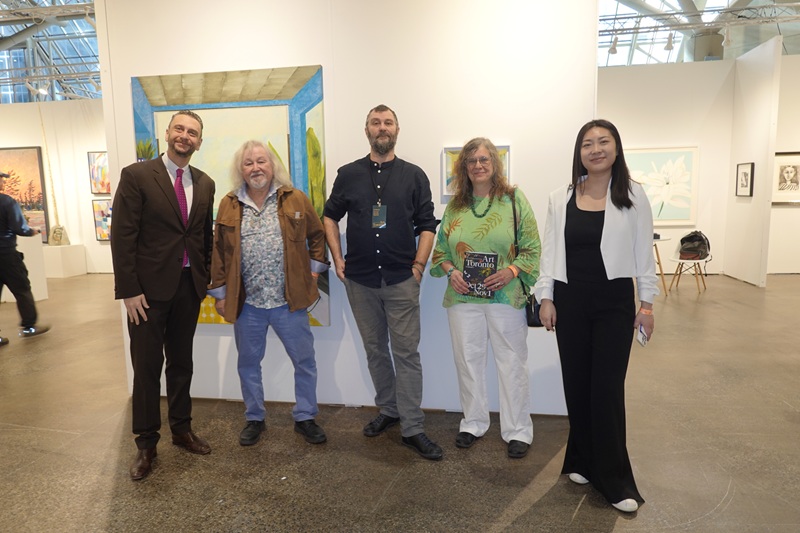
Another encounter brought Fang into direct contact with Canadian painting history. At the Canadian Fine Arts Gallery booth, she joined Janzen, Nowak and Wil Kucey, the gallery’s senior art advisor, for a photograph in front of an oil painting by Alfred Joseph Casson, better known as A. J. Casson.
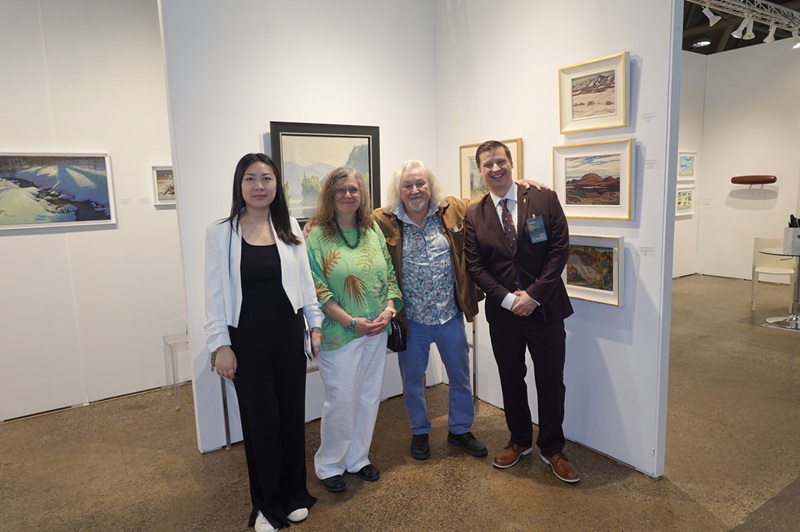
Based in Toronto’s Yorkville neighbourhood, Canadian Fine Arts Gallery handles historical, modern and contemporary Canadian art. Its 2026 Art Toronto presentation included works by members of the Group of Seven, providing a setting for Fang to encounter an influential chapter in Canadian landscape painting.
Casson joined the Group of Seven in 1926 following Frank Johnston’s departure. His paintings of Ontario’s towns, villages and rural landscapes are known for their clear outlines, structured compositions and simplified planes. He was also a founding member of the Canadian Group of Painters.
For Janzen, the encounter had a personal significance: Casson was his mentor. Viewing the painting with Fang connected the historical work on display with Janzen’s own artistic development and his role in guiding her Canadian visit.
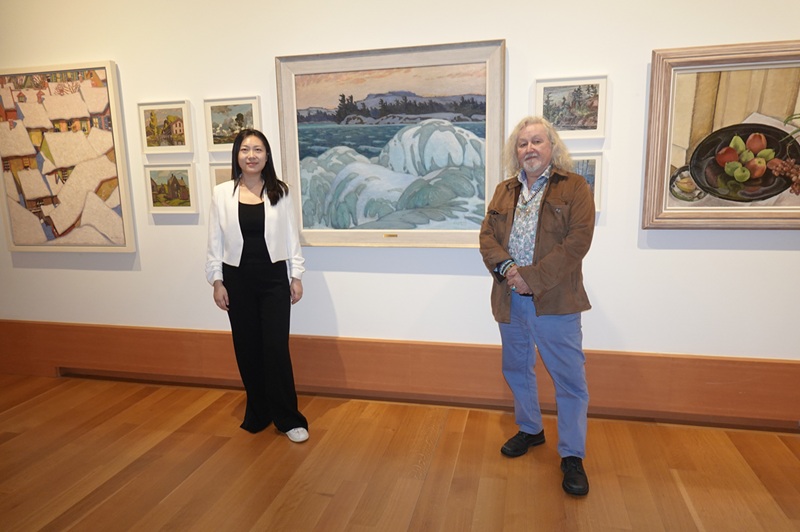
After Art Toronto, Janzen personally guided Fang through the Art Gallery of Ontario, introducing its collections and the work of the Group of Seven. The AGO is one of North America’s largest art museums, with holdings spanning Canadian and Indigenous art, European masterpieces and contemporary practice. During the visit, Fang and Janzen were photographed beside a Casson work in the museum’s permanent collection.
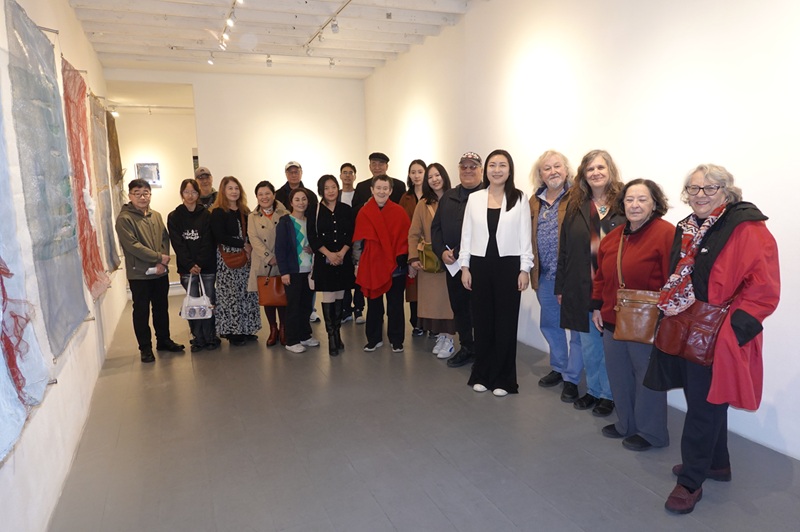
The following evening, at 6 p.m. on Oct. 30, From Here, What Remains opened in Toronto, bringing together more than 30 guests, including artists, Chinese-language media professionals, cultural representatives and arts enthusiasts.
Janzen delivered the first of the evening’s three official addresses. Drawing on four visits to China to participate in art exhibitions, he discussed cultural exchange between East and West in contemporary art, linking the occasion to his own experience of exhibiting internationally.
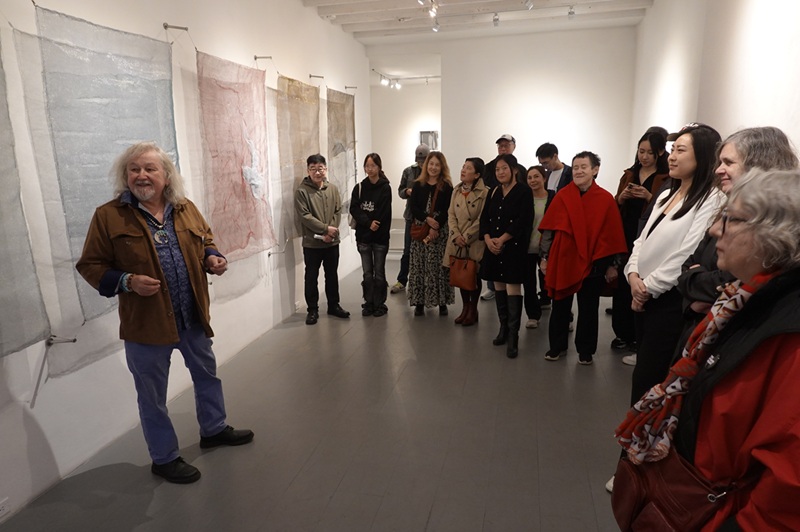
Lixia Ma, president of the Canadian Association of Chinese Journalists and Editors and executive editor of International Arts News, spoke next. On behalf of the media association, she welcomed Fang’s exhibition and extended her best wishes for its success.
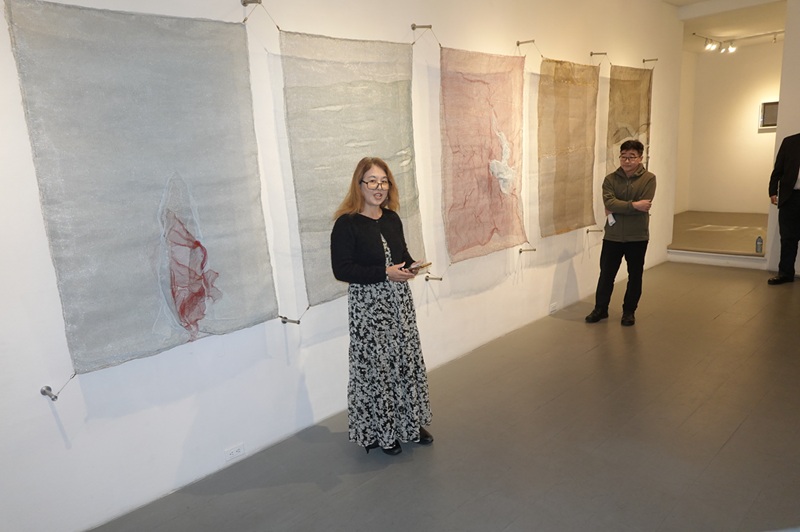
Zhao Pincheng, general manager of Canada & World Report and operations team leader for the World Agarwood and Agarwood World e-commerce platforms, addressed the relationship between agarwood and art. He said the two platforms would build ties with the arts and support exhibitions and exchanges between East and West, expressing support for the principle of art without borders.
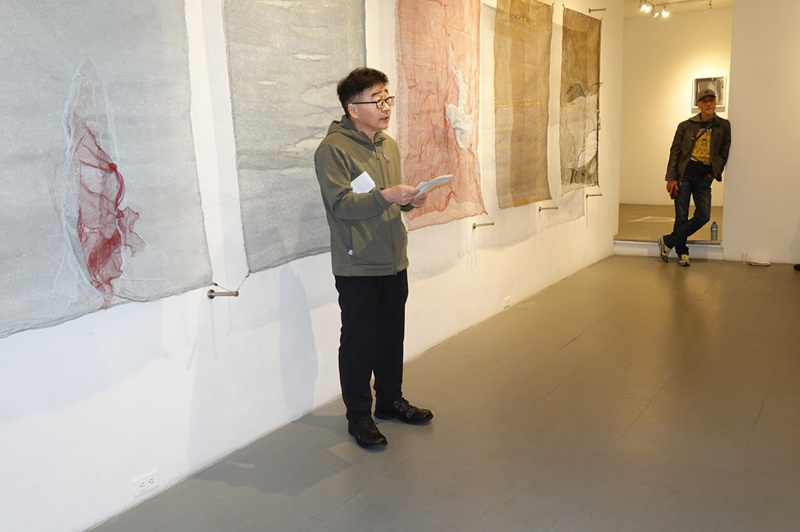
Fang then thanked the guests for their support and said she had benefited greatly from the artistic exchanges in Toronto. She invited visitors to offer comments and suggestions about the exhibition.
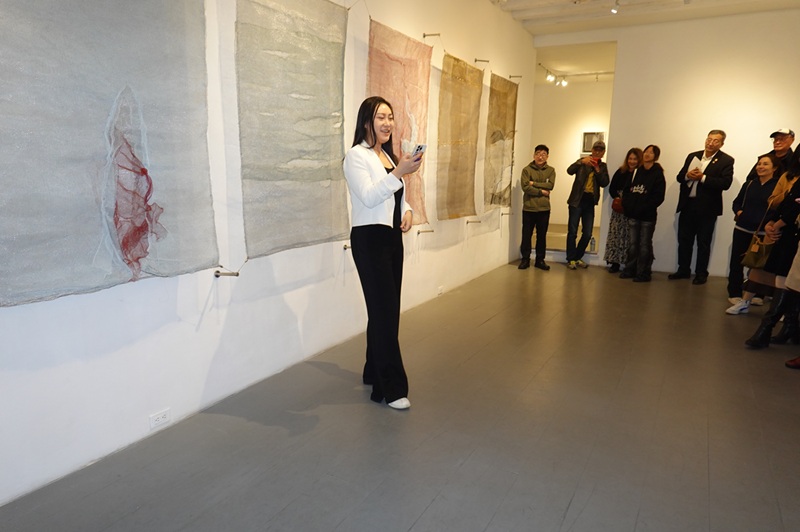
Guests included Yu Congzhang, chairman of the board of directors of the Atlantic Cultural and Arts Exchange Association; Timur Zhao, president of the Confederation of Chinese Alumni’s Association; Zhang Xujing, vice chairman of the World Foundation of Chinese Mass Media, and Deng Lanyue, a director of the foundation; Shifu, a pioneer of Iconographic Art; and Xue Ding, a candidate for Toronto City Council in Ward 10, Spadina–Fort York, in the 2026 municipal election.
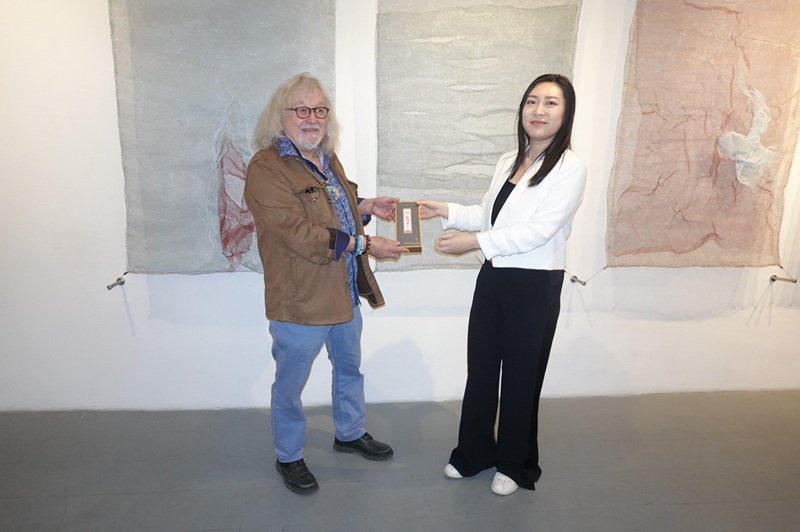
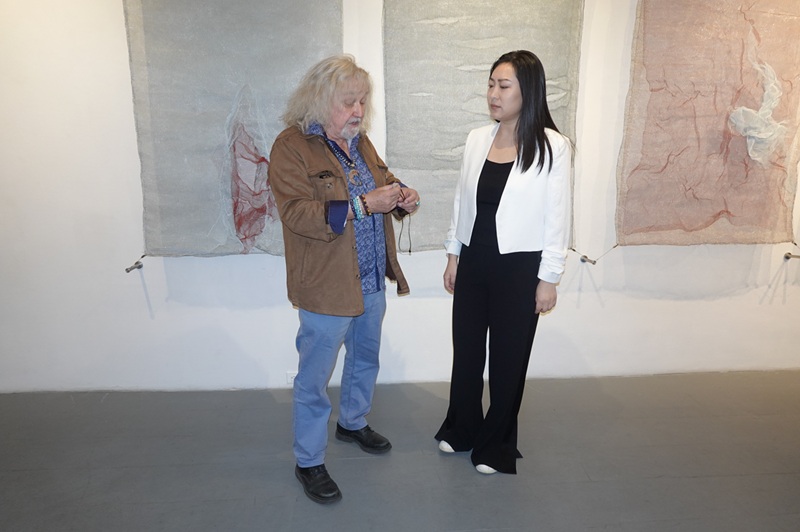
A gift exchange also marked the opening. Fang presented Janzen with agarwood products from Hainan, while Janzen gave her Canadian First Nations craftwork.
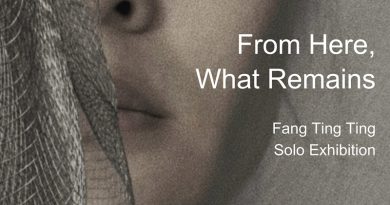
The exhibition itself examines how family, personal loss and childhood experience continue to shape identity. Through hand-stitched metal mesh, mirrors, photography, moving image and participatory installations, Fang considers how people and experiences that have disappeared from daily life remain present in habits, gestures and ways of seeing.
In her exhibition statement, Fang recounts losing substantial bodies of artwork in accidents on three occasions. The destruction led her to question the meaning of making objects that might not survive. Her grandfather’s death brought a further awareness of how the loss of a person can also seem to close a connection with an earlier era.
The work turns towards forms of continuity that survive beyond physical objects. Fang stitches metal mesh with wire using movements learned from her grandmother, who taught her needlework and quilt sewing. The material also recalls the window screens of her childhood home, whose grids offered protection while imposing boundaries on her view of the outside world.
The five-part Life series presents Birth, Childhood, Youth, Post-Youth and Death. Each work measures 100 by 150 centimetres. Cuts, knots, layered surfaces and visible joins give the shared material different forms, drawing attention to the pressures, relationships and transformations experienced over a lifetime.
Within assembles 194 small mirrors and flexible reflective film inside a wooden frame. A regular central grid produces a recognizable reflection, while surrounding surfaces bend and distort the image as the viewer moves. The work explores how a sense of self is assembled through social judgments, family expectations, memory and imagination.
In Still the Same Net, five green mesh panels of different sizes and thicknesses hang from a bar made of five joined metal sections. The panels overlap but retain their individual forms, while black chains suggest both the connections and constraints of family relationships.
Among Five returns to memories of a household comprising two grandparents, two parents and a child. Five human outlines made from aluminium wire are distributed through the exhibition space at different heights and in everyday poses, allowing visitors to discover them gradually.
The 52-second video What If It’s Just This? combines five recordings of Fang cutting metal mesh on different days. Their images and original sounds disappear at different times. Presented on a vintage radio-style digital media player, the work recalls her grandfather’s habit of tuning the radio.
Withdrawing Expectations combines a photograph of Fang’s face partly obscured by mesh with her exhibition statement, printed on a large fabric poster. Its folded lower section conceals part of the text, bringing expression and concealment into the same work.
Visitors can also contribute to Leave Your Mark, an ongoing participatory installation using cotton canvas and fabric paint markers. Signatures, words, drawings and simple lines become part of the work alongside marks left by other participants.
Fang began studying painting in childhood and later studied art in China, Japan, the United Kingdom and the United States. Her practice spans painting, installation, photography, moving image, poetry and spatial work.
As a curator, she initiated A Manifesto, an international exhibition series supporting emerging and underrepresented artists. Over the past five years, she has organized exhibitions, forums and other projects in Paris, Venice, London, Riyadh and Hong Kong.
Her recent curatorial projects include A Manifesto II at the Carrousel du Louvre in Paris in 2025; Art and Making: Material Culture, Craft and Emerging Practices, organized by the Asian Academy of Arts at the British Museum’s BP Lecture Theatre and East Foyer in London on March 4, 2026; and Voices, Amplified: A Manifesto, held in Venice from Aug. 15 to 22, 2026, during the period of the 61st International Art Exhibition of La Biennale di Venezia. She has also been appointed director of the IFAA Center for Curatorial Affairs.
The Canadian exchange continued after her own opening. At about 8 p.m. on Oct. 30, Janzen accompanied Fang to nearby Clint Roenisch Gallery, at 190 St Helens Ave., for the opening of Greg Staats’s solo exhibition Just Now Or At This Moment, Oh’n-woh.
Staats, a Toronto-based artist born in 1963 in Ohsweken, Six Nations of the Grand River Territory, identifies as Skarù:reˀ (Tuscarora) / Kanien’kehá:ka (Mohawk). His practice explores language, memory, trauma and renewal through text, photography, embodied wampum sculpture, performance, installation and video.
His work develops a Hodinöhsö:ni’ restorative aesthetic grounded in language and relationships with land and community. His lens-based practice describes cycles of return towards Onkwehón:we neha, or “our original ways.” The visit brought Fang’s Toronto itinerary into contact with contemporary Indigenous artistic practice.
Founded in 2003, Clint Roenisch Gallery represents artists across generations working in photography, sculpture, painting, film and installation. It has presented the first Canadian solo exhibitions of international artists and practices including Roger Ballen, Marcel van Eeden and Studio Morison.
Artists associated with the gallery have exhibited at, or had work acquired by, institutions and international exhibition platforms including the Museum of Modern Art (MoMA), the Centre Pompidou, the National Gallery of Canada, the Venice Biennale, the Guggenheim, the Berlin Biennial, the Montreal Museum of Fine Arts, the Vancouver Art Gallery, the State Museum of Russia, the Stedelijk Museum and The Power Plant.
At the gallery, Janzen also introduced Fang to Carlos Galdamez, owner of Acadia Bookstore, also known as Acadia Art and Rare Books. They posed for a photograph together, extending the evening’s encounters to another part of Toronto’s cultural community.
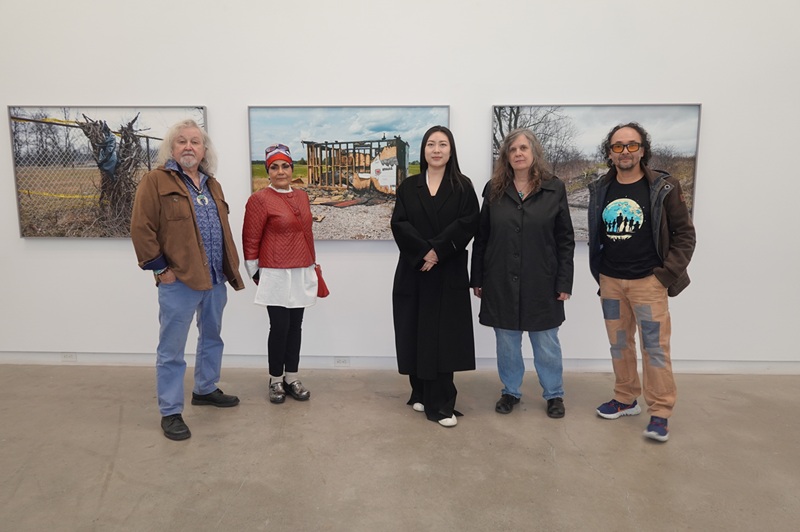
From Here, What Remains runs from Oct. 30 to Nov. 1, 2026, at 2104 Dundas St. W. in Toronto. Weekend viewing hours are 10 a.m. to 12:30 p.m. and 2 to 6 p.m. Admission is free, and no booking is required.
Media contact:
Steven Zhao
Canada & World Report
zhao@canadanewsreport.com