Toronto Mayoral Candidate Weizhen Tang: Reshaping the City’s Economy Through Quantitative Fiscal Reform
TORONTO, Ontario, Canada, September 22, 2026—Zhang Wei, Toronto News Net—As Toronto’s 2026 municipal election enters a critical stage, housing affordability, public safety, transportation and the cost of living have emerged as major issues addressed by candidates. Election Day is scheduled for Oct. 26, with advance voting taking place from Oct. 6 to 11.
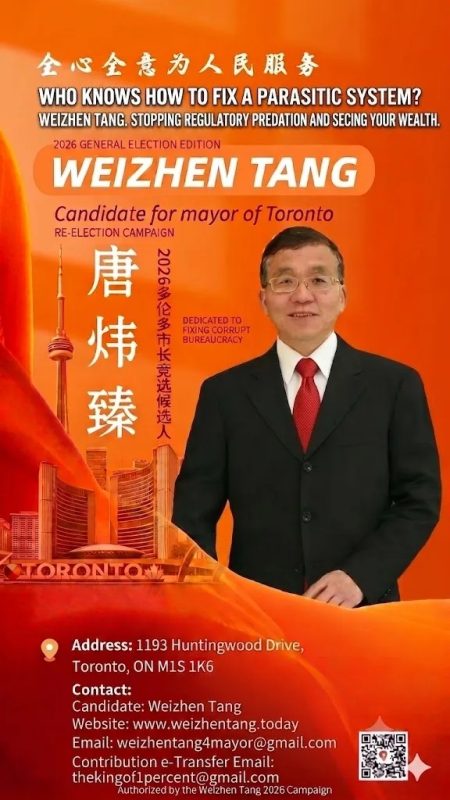
Weizhen Tang, who is running for mayor of Toronto for the third time, is seeking to bring fiscal efficiency, public asset management and economic risk control into the election debate. In an exclusive interview with this newspaper, Tang outlined what he calls a “Quantitative Fiscal Restructuring and Governance Framework,” which would apply performance indicators, balance-sheet analysis and risk-management tools to the City’s budgeting, project delivery and public asset management.
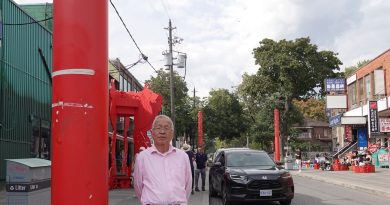
During the interview, Tang spoke relatively little about his personal political ambitions, focusing instead on Toronto’s long-term fiscal pressures and project-delivery challenges.
“Politicians focus on winning votes; reformers focus on structural problems,” he said. “Toronto does not need more promises. It needs less waste and greater efficiency.”
Tang argues that pressures in housing, transportation, community services and public safety do not result entirely from a lack of money. In his view, some problems are also connected to budget allocation, departmental coordination, project execution and the way outcomes are evaluated.
He believes Toronto should gradually move away from relying mainly on higher taxes and increased spending and instead concentrate on improving the value generated by every dollar of public money.
The City of Toronto’s 2026 operating budget totals $18.9 billion, while its 2026–2035 capital plan amounts to $63.1 billion—the largest capital plan in the city’s history. Approximately 53 per cent of the capital investment is allocated to maintaining and renewing existing infrastructure.
In Tang’s view, the size of the budget reflects not only the complexity of Toronto’s public-service responsibilities but also the need for the City to explain more clearly the relationship between spending, project progress and measurable results.
He compares Toronto to a major public institution with an annual operating budget approaching $20 billion.
“When a business expands its budget, it must examine costs, returns, cash flow and risk,” Tang said. “A municipal government is not intended to make a profit, but it must still know how much a project costs, whether it is completed on time and what residents ultimately receive from it.”
Toronto already publishes budget documents, departmental performance indicators and audited financial statements. The City also has an Auditor General’s Office that conducts performance audits and assesses whether municipal programs provide value for money. Tang argues that the existing system can be strengthened further, particularly by linking budget allocations more directly to verifiable service outcomes.
Under Tang’s proposed framework, fiscal reform would begin with changes to the way the budget is prepared. He advocates the phased introduction of output- and performance-based zero-based budget reviews, rather than automatically using a department’s previous spending as the starting point for the following year’s budget.
Under this model, departments and programs selected for review would periodically be required to justify their policy objectives, operating costs, intended beneficiaries and expected results. Performance indicators could include the number of affordable homes created or preserved, permit-processing times, public-transit reliability, infrastructure project progress, service wait times and the cost of delivering each unit of service.
Tang stresses that zero-based budgeting should not be understood as an across-the-board spending reduction. Instead, he describes it as a management tool for establishing priorities.
“Services that should be preserved must be preserved, and spending can be increased where necessary,” he said. “But the government should use evidence to explain why an increase is needed and what results that additional investment will produce.”
Recognizing that a complete annual zero-based review of every municipal program could create significant administrative costs, Tang proposes a rotating system organized by department, project size and level of risk. Priority would be given to projects with rapidly increasing budgets, long-term delays or repeated contract amendments.
The second component of Tang’s plan is the creation of a more comprehensive and dynamic municipal balance sheet. He wants the City to develop a clearer picture of the purpose, maintenance costs, utilization rates and long-term value of its land, office properties, parking facilities, transit-related properties and other public assets.
His proposal would distinguish between assets required to provide essential public services and those with potential commercial or development value.
Toronto already has a corporate asset-management policy and has been consolidating office space and repurposing selected properties through initiatives such as ModernTO. The City’s real estate division manages hundreds of municipally owned facilities.
Tang says his proposal is not simply about selling municipal land or privatizing public facilities. Instead, while preserving public ownership and essential services and complying with debt and audit requirements, he wants the City to consider options such as long-term leases, joint development, space consolidation, the use of development rights and structured financing.
He says some municipal properties that have remained vacant or underused for extended periods could be directed toward housing, community services or small-business development. Projects with stable revenue streams could also be considered for alternative financing arrangements, reducing their dependence on property taxes and conventional municipal borrowing.
Such arrangements, however, would raise questions about asset valuation, borrowing costs, credit ratings, public control and intergenerational fairness. Tang acknowledges that any specific proposal would require an independent financial assessment, legal review, risk stress testing and public consultation. He says short-term financing proceeds should not be treated as long-term fiscal revenue.
The third component of Tang’s framework concerns oversight and accountability. He proposes a citywide performance-review mechanism that would bring together information on budget changes, contract amendments, project delays and service outcomes, with standardized data made publicly available.
Toronto already has several independent accountability offices, including the Auditor General, Integrity Commissioner, Ombudsman and Lobbyist Registrar. Tang says the new mechanism should not duplicate their work. Instead, it would integrate information currently dispersed across different departments and create a clearer connection among budgeting, procurement, contract execution and project results.
For procurement contracts above a specified financial or risk threshold, Tang proposes disclosing evaluation criteria, the reasons for selecting the successful bidder, significant contract changes, actual payments and project progress, subject to legal requirements and legitimate commercial confidentiality.
Independent auditors and forensic accountants could be asked to examine unusual costs, repeated delays and potential conflicts of interest.
“Transparency is not simply putting documents online,” Tang said. “Real transparency means allowing ordinary residents to understand how much a project was originally expected to cost, why the price later increased, who approved the change and whether the project ultimately achieved its original objectives.”
In addition to internal fiscal reform, Tang identifies Canada-U.S. trade tensions and supply-chain disruptions as significant external risks to Toronto’s economy.
According to Ontario’s Financial Accountability Office, the United States was the destination for 83.3 per cent of Ontario’s international merchandise exports in 2025. In an earlier tariff scenario, the agency estimated that related trade disruptions could make Ontario’s economy 1.7 per cent smaller in 2026 and result in approximately 119,200 fewer jobs compared with a no-tariff baseline. These figures represent scenario-based estimates rather than inevitable outcomes, but they illustrate the risks associated with Ontario’s heavy reliance on the U.S. market.
Tang argues that Toronto cannot separate itself from the North American economy and should not abandon its traditional connections with the United States. However, he believes the city needs additional safeguards against external economic shocks.
“A city’s economy is similar to an individual investment portfolio,” he said. “If it becomes excessively dependent on a single market, its room to adjust will be limited when government policy or market conditions change.”
Tariffs and international trade agreements fall primarily within federal and provincial jurisdiction. A municipal government cannot set tariffs or negotiate national trade agreements. Tang therefore focuses his proposed municipal measures on investment attraction, export assistance, supply-chain information, employment lands, more efficient approval processes and international city-to-city cooperation.
While strengthening Toronto’s position in the North American market, he wants the City to expand its commercial connections with Europe, Asia, the Middle East, Latin America and other emerging markets.
He also proposes using the language skills, cultural knowledge and international networks of Toronto’s diverse communities to help local small and medium-sized businesses identify new customers, suppliers and investment partners.
During the interview, Tang also discussed the pressures confronting local small businesses. He argues that many merchants are concerned not only about tax rates but also about the time and uncertainty associated with permits, inspections, planning reviews and coordination among municipal departments.
“Opening a restaurant, retail store or small service business can involve several permits and inspections,” he said. “If applicants do not know how long the process will take or whether different departments have consistent requirements, it becomes extremely difficult to plan rent, renovations, hiring and cash flow.”
Tang proposes a one-stop permit coordination platform for small businesses, providing applicants with a single project number, a standardized document checklist, estimated processing times and a way to track the status of their applications.
Qualifying low-risk applications could follow a standardized review process. Projects involving fire safety, building safety, food safety or significant planning changes would remain subject to the necessary professional inspections and regulatory reviews.
Tang says streamlining the process would not mean weakening safety standards. Instead, the objective would be to reduce repetitive document submissions, poor information-sharing among departments and extended periods during which applicants receive no clear decision.
“The resilience of a major city is not measured only by data from large corporations and financial institutions,” Tang said. “It also depends on the stable cash flow of thousands of neighbourhood shops, restaurants, professional-service firms and small businesses.”
Housing is also connected to fiscal and administrative efficiency, Tang argues. In the relationship among landlords, tenants and government, he believes the City possesses land, planning authority, permitting systems, community services and coordination resources that give it room to help resolve some housing problems.
He says municipal authorities should not act only after disputes have occurred. They could also help prevent avoidable housing losses by activating vacant housing, improving rental information services, coordinating communication between landlords and tenants, supporting community housing partnerships and making permit processes more efficient.
On long-term fiscal sustainability, Tang opposes continuously increasing debt and fixed expenditures without a clear assessment of future returns. He proposes a dynamic asset-and-liability management system that would publicly evaluate the purpose, term, repayment source and risks of new municipal debt while tracking infrastructure-maintenance backlogs and future service costs.
He believes assets used for public services should be managed primarily to protect those services over the long term. Assets with commercial income or development potential could be used more efficiently, provided that the public interest remains protected.
Revenue generated from public assets, he says, should be directed primarily toward long-term priorities such as infrastructure renewal, housing and public transit, rather than being treated as one-time income to cover recurring operating expenses.
Tang summarizes his overall governance approach through four interconnected objectives: linking budgets to results, using public assets more effectively, making major project risks traceable and reducing Toronto’s economic dependence on a single external market.
“Good urban governance means sustainable public finances, productive assets, protection against risk and a city in which ordinary people can afford to live and work,” Tang said.
Whether the framework can be converted into workable municipal policy will depend on several practical considerations, including the City of Toronto’s legal authority, the implementation costs of the reforms, the effects of proposed financing structures on Toronto’s credit rating and borrowing costs, and how any new oversight mechanism would work with existing accountability offices.
As the campaign progresses, Tang will still need to provide more detailed implementation schedules, cost projections, performance benchmarks and risk limits. For voters, those details will be important in determining whether his proposed quantitative fiscal reform is primarily a campaign concept or a practical model of municipal governance.