
ECOWAY®: Building a Canadian Smart-Bathroom Brand for North American Growth
TORONTO, Ontario, Canada, Aug. 17, 2026 —Shaoren Gou, Canada & World Report — ECOWAY® is preparing to take a Canadian smart-bathroom business model into the United States after building a product, channel and service network across major Canadian provinces. The company’s proposition extends beyond selling intelligent toilets: it combines North American product definition, global manufacturing, approximately 200 dealers and partners, third-party fulfillment, local repair coordination, replacement-parts support, a formal warranty structure and product-liability insurance.
The business was established in 2017 by founder and chairman Shanda “Dave” Lin, its sole owner. Lin’s earlier experience in restaurants, tourism and cabinetry helps explain several operating choices, but ECOWAY’s current news value lies primarily in the company it has built: a Canadian brand seeking to localize smart-bathroom products, support them after installation and transfer that model to a larger North American market.
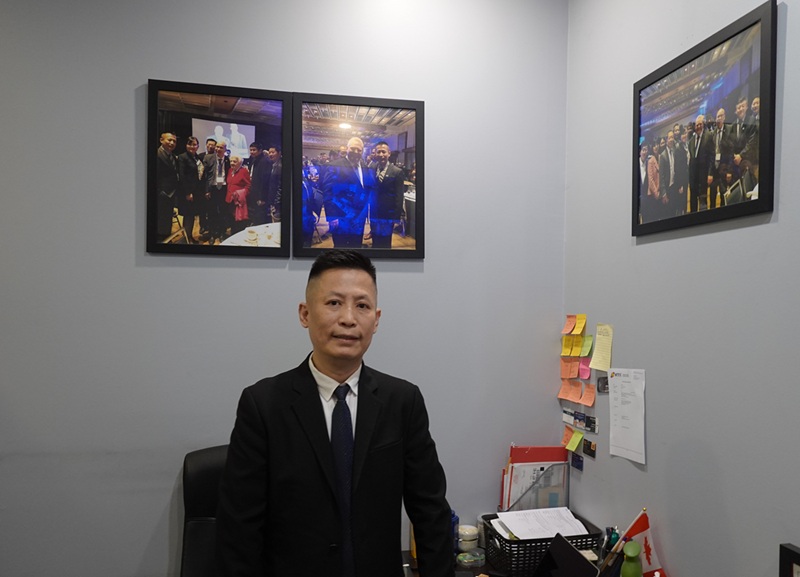
ECOWAY® founder and chairman Shanda “Dave” Lin at the company’s Toronto-area headquarters.
1. The Business Premise: In Smart Bathrooms, Experience Extends Beyond the Product
ECOWAY’s operating premise is that a bathroom product cannot be judged only by specifications or the moment of sale. Delivery, installation, fit, hygiene, maintenance, parts availability and the response to a complaint all become part of the product experience. That is why the company places unusual emphasis on video diagnosis, installation guidance, local technicians, replacement parts, written warranty terms and liability coverage alongside design and pricing.
The service emphasis is informed by Lin’s earlier restaurant and tourism work in the United States and Canada. Hospitality provided immediate customer feedback, while tourism required coordination across multiple suppliers and service links. Those lessons now support a company system connecting a manufacturer, national platforms, dealers, third-party warehouses, installers, repair technicians and households. The founder’s history is relevant mainly because it helps explain the structure ECOWAY uses today.
2. Understanding the Home: Why Installation Shapes the Brand
A smart toilet is not a stand-alone consumer electronic device. Water pressure, electrical supply, drainage, dimensions, installation quality, maintenance, cleaning practices and local requirements can determine whether the product succeeds in a particular home. ECOWAY therefore treats compatibility and after-sales support as part of product development rather than as issues to address only after a sale.
Lin’s 2008 move into cabinetry and building materials supplied useful knowledge of North American homes, contractors and renovation decisions. Cabinets must match measurements, structures, installation conditions and long-term use; bathroom products face a similar requirement to function within a living system. That background became one source of ECOWAY’s localization approach, but the result is institutional: feedback from homes and tradespeople is returned to the Canadian team and converted into specifications, manuals, parts and training.
3. Founding ECOWAY in 2017: Building a Canadian Brand, Not Simply Importing Products
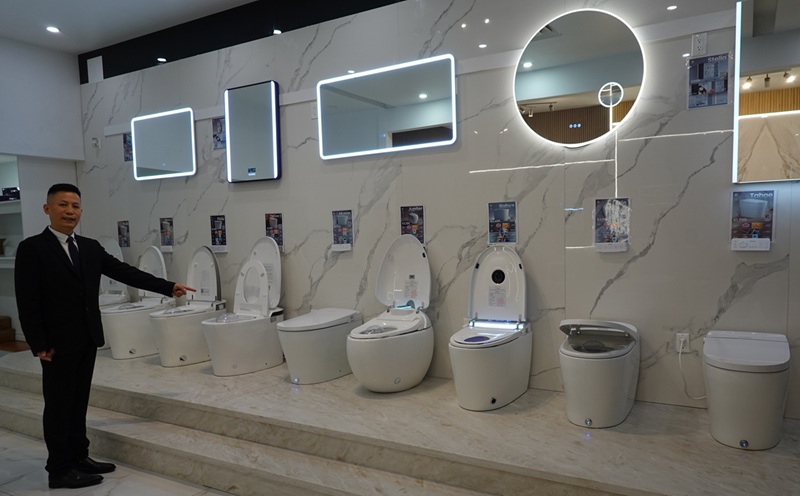
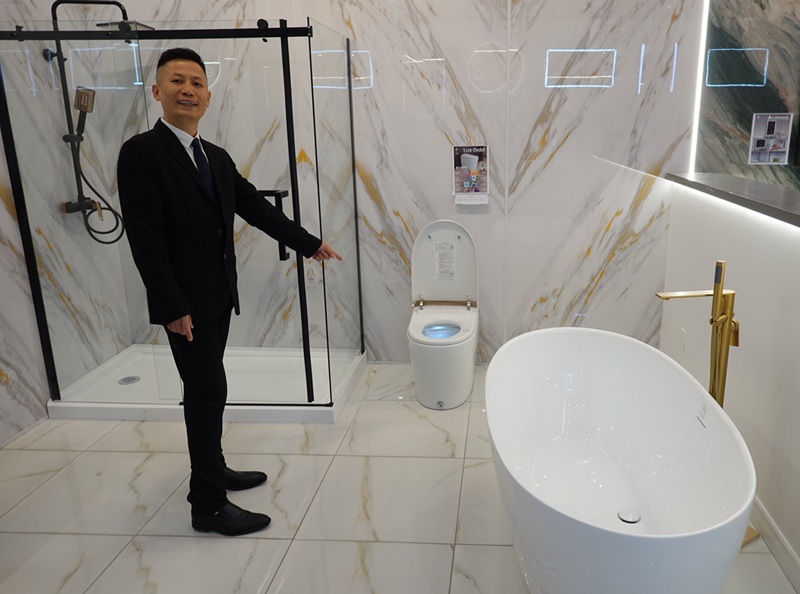
Lin formally established the company in 2017 with a focus on higher-end smart bathroom products. Its core categories include smart toilets, LED bathroom mirrors, vanities, bathtubs and related bathroom products. The portfolio also extends to a sensor-operated hygienic seat-cover system intended for restaurants and other public locations. When a user activates the device, a sanitary film advances around the seat, reducing the need for manually replaced paper covers.
Lin emphasizes that ECOWAY is a Canadian brand. The products are manufactured in China, but the company says its model is not based on selecting an off-the-shelf item and adding a private label. ECOWAY defines requirements around Canadian and North American spaces, functions, user habits and after-sales feedback. A leading publicly listed Chinese sanitary-ware company works with the brand on design adaptation and production. According to ECOWAY, that manufacturer is its core and currently sole supplier and has an established in-house production and intellectual-property base.
Products enter the market under the ECOWAY name, and their appearance, configuration and functions are iterated according to the brand’s requirements. The point is not to deny the global nature of manufacturing. It is to clarify responsibility: who defines the customer need, who validates the product, who provides service and who remains accountable to dealers and households. ECOWAY’s objective is to combine China’s manufacturing capacity with Canadian product definition, market testing and local support.
“We are not trying to keep changing industries. Bathrooms are our long-term business. We want to bring truly good bathroom products to the local market and complete the service around them.”
– Shanda “Dave” Lin
4. ‘Expect Better’: Making a Better Way of Living More Attainable
ECOWAY summarizes its brand principle in the words ‘Expect Better.’ The phrase applies to design and function, but also to the relationship between affordability and responsibility. A product does not have to be at the top of the price range to provide credible hygiene, comfort, appearance and support. The company says it seeks a balance among modern living, home design, health, sanitation and environmental awareness.
Company materials divide that promise into three themes. The first is environmentally conscious innovation. Water-saving, hygienic and intelligent functions may already exist in premium products, but many households cannot justify a luxury price. ECOWAY seeks to use a scaled supply chain to make smart-toilet technology available to a broader market. The second theme is design. A bathroom is a private space, and the shape, finish, lighting, controls and physical comfort of a product matter alongside reliability. The third is health and hygiene, addressed through washing functions, sensor-based operation and systems designed for easier maintenance.
Lin describes the desired position as ‘mid-market price, first-class quality.’ In the interview, he said key smart toilets ranged from roughly C$500 for entry configurations to more than C$2,000 for premium units, with some high-end models approaching C$3,000. The company is not pursuing the lowest possible price. It wants a broad enough range to serve different households while making mid- and upper-tier products the commercial backbone.
5. A Product Road Map, Not a Static Catalogue
The names in ECOWAY’s catalogue show a pattern of iteration. Deluxe and Deluxe 2.0, or Mono and Mono 2.0, indicate updated generations within the same family. Lux, Lux Pro and Lux Gold address different functions and visual preferences. Smart mirrors named Aurora, Luna, Halo and Stella form a separate line. Lin referred to approximately 11 smart-toilet models in active focus at the time of the interview, while the full list supplied by the company includes additional versions, configurations and related products.
| Category | Named products and product scope |
| Smart toilets | Baby+, Deluxe 2.0, Deluxe, Erie, Huron, Jupiter, Lux Gold, Lux Pro, Lux, Mono 2.0, Mono, Neo Pure, Taheo |
| Smart mirrors | Aurora, Luna, Halo, Stella |
| Other products | Komfy 100, Komfy 150, Neo Flow; bathroom vanities, bathtubs and a sensor-operated hygienic seat-cover system for public settings |
Lin compares the evolution of smart-bathroom products to the evolution of phones: appearances and functions change with consumer preferences. That makes speed important, but it does not eliminate testing. ECOWAY assigns staff to collect market information and customer feedback. When a new product arrives, the team checks whether the real functions match the manual and whether the controls make sense for local users. If a product falls short, the manufacturer is asked to modify and resample it until it meets the expectations set for the Canadian market.
This feedback loop is central to ECOWAY’s localization. Dealers, installers, repair technicians and households use products under different conditions across Canada. Their questions and complaints return to the Canadian team, which can turn them into improvements to specifications, manuals, parts and training. In that model, an overseas market is not merely the final destination of a supply chain; it is the starting point for the next product decision.
6. From Major Online Platforms to Approximately 200 Local Partners
Since 2017, ECOWAY has built a combination of retail and wholesale relationships. According to the company, its products reach consumers through major retail or online channels including Costco, Amazon, Home Depot, Lowe’s and Walmart. At the same time, approximately 200 dealers and partners operate across major Canadian provinces, including British Columbia, Alberta, Manitoba, Ontario and Quebec. The network is most concentrated in Ontario.
National platforms provide reach and recognition; local partners provide display, explanation, installation, repair and word-of-mouth trust. Smart toilets sit between appliances and building products, so both layers matter. A customer can purchase online, but satisfaction depends on whether the product arrives safely, fits the installation conditions and can be serviced when something goes wrong.
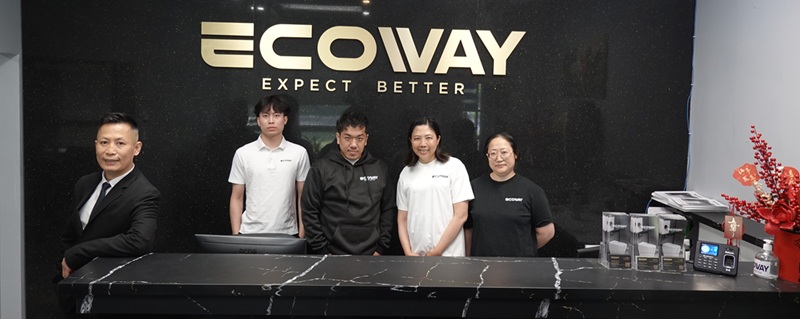
The company currently uses a relatively asset-light operating model. About 10 employees are paid directly through the Canadian headquarters, while several dozen contractors and external partners support the wider business. Warehousing and fulfillment are handled through third parties, with a Scarborough facility providing drop shipment. Once an order enters the system, designated staff process it and send it to the warehouse for dispatch. The structure allows the core team to focus on products, channels, customer service and market development while using specialized logistics providers for reach.
Lin says ECOWAY’s sales have grown by more than 20% annually since the company was established, including during the pandemic, and he put 2025 sales at approximately C$5 million. He also offered a rough estimate based on overall toilet sales in Canada and said the company had gained a significant position in the smart-toilet category. Those growth and market-share statements are company or interviewee figures, not third-party audited statistics.
7. One Featured Product Every Month: Building a Brand Through Repeated Visibility
One detail in Lin’s account reveals how the company approaches brand-building: for years, it has selected one product each month for a focused promotion. This is not presented as a short-term clearance strategy, but as a way to keep the brand and its product range in front of consumers. A mid- to upper-tier smart toilet normally priced at about C$1,500, for example, might be promoted at C$1,199, a reduction of roughly 20%.
The cadence gives retail platforms a steady source of promotional activity and helps ECOWAY observe demand at different prices, configurations and times of year. Lin says popular mid- and upper-tier models sometimes generate individual orders of more than 10 units and occasionally around 20. For a bathroom brand grown in Canada, such orders represent more than immediate volume; they suggest that a contractor, dealer or project buyer is prepared to place the product in multiple homes.
What Lin calls a market-tested business model is therefore built from repeated, practical events: a platform continues to carry or promote the brand; a dealer is willing to stock it; installers become familiar with the products; customers choose mid- and high-end configurations; service issues are addressed; and the next generation changes in response. A durable brand is less likely to result from one dramatic launch than from years of steady presence.
8. After-Sales Support as ECOWAY’s Hardest Product to Copy
Lin is more eager to explain the national service process than a single flushing specification. When customers report a problem, they can record a video and send it to the team. ECOWAY uses video to diagnose the issue and provide guidance, and it has created installation and repair videos for customers and local service personnel. When an in-person visit is required, the company can arrange a local cooperating technician on a case-by-case basis and pay for the applicable service.
As the relationships continue, technicians in different regions become more familiar with ECOWAY products. The brand supplies them with ongoing installation and repair work; in return, the company gains a distributed network of people with product knowledge. Replacement parts are dispatched as quickly as conditions allow, with rapid arrival treated as a service objective in regions where logistics make it possible.
Returns demand special caution because smart toilets are hygiene products. Lin says a unit that has been used, or whose sanitary condition cannot be assured, is not returned to the market as a new product. Returned items are evaluated and handled accordingly, while genuinely new and safe components may be retained for future repairs. The approach increases costs, but it protects the level of trust consumers should be able to expect from a bathroom brand.
9. A Burst-Pipe Case and the Boundary of Responsibility
Lin described a case involving a customer from the Home Depot channel and a burst water pipe. The original complaint associated the loss with the company’s product. Information obtained later indicated that the problem involved an external pipe, which did not automatically establish fault on the part of ECOWAY. The company nevertheless referred the case immediately to its insurer for investigation and a formal assessment of responsibility instead of requiring the customer to chase multiple parties.
The example is not proof that a product can never fail. Its significance lies in the way a company handles uncertainty. A customer’s loss needs to be taken seriously, while causation and legal responsibility must be determined by evidence and professional investigation. If a claim falls within covered responsibility, the insurance process responds. If the product did not cause the damage, the conclusion still needs to be documented and explained.
ECOWAY has carried product-liability insurance since entering the smart-bathroom business in 2017. Lin says the current coverage is approximately C$8 million and applies across online and offline channels. Major platforms initially required insurance as a condition of participation, but the company extended that protection across the wider business. Insurance cannot replace quality control, yet it demonstrates that the company recognizes the potential cost of a low-frequency, high-loss event.
10. A Formal Warranty Structure: Turning a Promise Into Executable Terms
ECOWAY’s formal warranty statement provides a more complete structure than a conversational summary. Smart toilets carry a three-year limited warranty. During the first year after purchase, the company may replace a product when a factory defect is confirmed. During the three-year period, the smart bidet-seat assembly and electronic or functional components that can be separated from the porcelain body – including, on applicable models, kick buttons, flush valves and water tanks – are covered under the stated parts and replacement terms. The porcelain base has a limited lifetime warranty that is restricted to one installation and is not transferable.
The warranty applies to the original purchaser, is nontransferable and requires proof of purchase, warranty registration, proper installation and normal use. The full terms apply to qualifying residential installations in North, Central and South America. Commercial use, or installation outside those regions, is subject to a one-year warranty under the supplied statement. Damage caused by natural disasters, misuse, inadequate maintenance, water-system sediment, improper installation, excessive water pressure, electrical surges, the wrong power supply or highly concentrated chlorine cleaners is generally excluded.
Those boundaries may appear technical, but they are necessary when a brand grows. A credible warranty does not make the vague promise that every problem will be covered. It explains what can be replaced, which components can receive parts, how a claim is submitted and when technical or insurance investigation is required. Lin’s shorthand – one-year replacement and three-year parts support – is therefore backed by a more specific three-year limited-warranty framework.
11. Canada as the Base, the United States as an Operating Plan
ECOWAY’s next step is to take the model developed in Canada into the United States. In February 2026, the company established a U.S. operating entity in Florida under the control of the Canadian headquarters. A bank account has been opened, local partners and a working team are in place, and the company says it has ordered inventory for the U.S. market. As of the interview, the goal was to begin first-phase sales around Halloween 2026.
Logistics planning is moving in parallel. A Los Angeles warehouse arrangement was in the process of being finalized to support the western United States, while the Florida team could serve the Southeast. For a central node, the company had considered cities such as Chicago or Atlanta. The final configuration will depend on order density, cost and channel progress, but the question has moved from whether to enter the United States to how to provide fulfillment and service across western, southeastern and eventually central markets.
That distinction matters. International expansion is often presented as a distant aspiration. ECOWAY says it has already completed several foundational steps: company registration, banking, local team formation and inventory arrangements. Expansion still carries risk and will require time to establish local service capacity, but the U.S. initiative has entered an execution phase rather than remaining only an idea on paper.
12. From Europe to the Middle East: Large Goals, Built Market by Market
After consolidating Canada and entering the United States, ECOWAY also sees Europe and the Middle East as longer-term possibilities. Lin said the company was in contact with builders or potential partners connected to Saudi Arabia and Dubai in the United Arab Emirates. In Europe, the brand would seek to adapt the positioning, responsibility practices and service structure developed in Canada, while recognizing that electrical, plumbing, certification and consumer requirements differ from country to country.
Lin has stated ambitious but staged goals. The long-term annual sales target for Canada is C$50 million, roughly 10 times the company-reported 2025 level. He expects the larger U.S. market to offer more potential than Canada, and he has discussed Europe as a possible C$100-million-level market over time. These numbers are company objectives, not achieved results or financial forecasts.
He does not describe those plans as another transformation of the business. Bathrooms are intended to remain the core category. Stabilizing Canada, entering the United States and then evaluating Europe and the Middle East represent extensions of the same business line rather than a series of unrelated pivots.
13. Community Engagement as a Supporting Part of Corporate Identity
Beyond running his company, Lin serves as president of the Canada Fujian General Association and takes an active role in community affairs. When people from Fujian or members of the wider community encounter difficulties and need assistance, he leads the association in responding, mobilizing members and community resources to provide practical support where possible. According to the interview, he also participates in Canada’s public and civic life through campaign-support activities at the federal, provincial and municipal levels and has made donations in support of candidates and related campaigns.
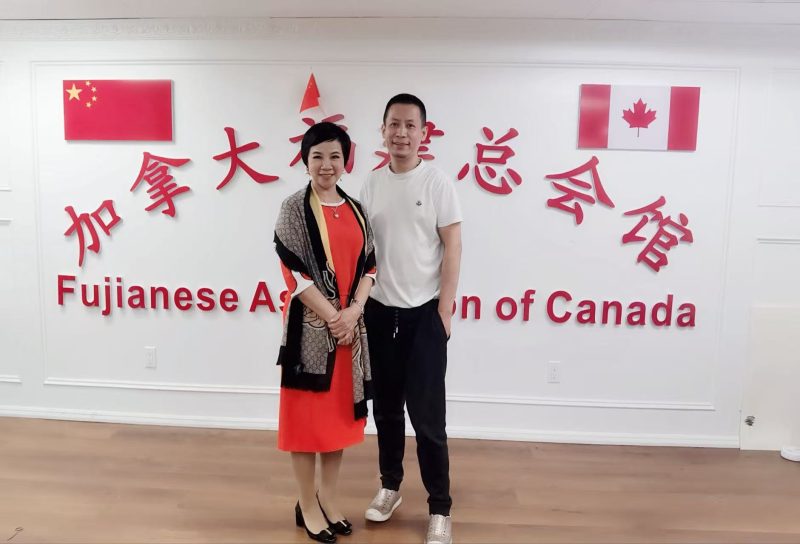
These activities are included as supporting context rather than as the central value of the company story. Their relevance to ECOWAY lies in the same practical requirements that shape its commercial network: long-term trust, coordination among participants and a willingness to respond when difficulties arise. The company’s primary identity, however, remains its smart-bathroom products, Canadian channel base, service system and planned market expansion.
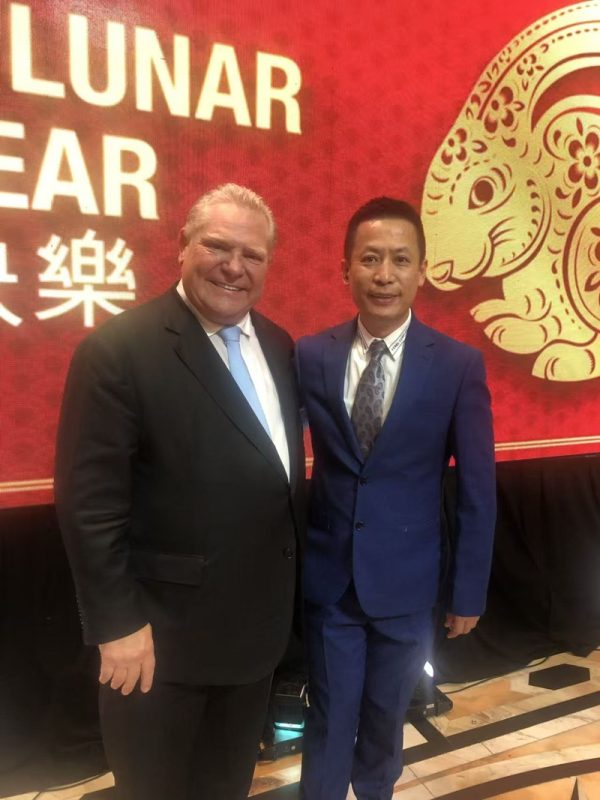
Shanda “Dave” Lin with Ontario Premier Doug Ford.
Better Products Also Require Better Responsibility
ECOWAY today seeks to be more than an importer moving smart-bathroom products from China into Canada. Its intended position is that of a brand defined by the Canadian market, enabled by global manufacturing and supported through local accountability. Its competitive system includes product and pricing, but also approximately 200 channel partners, third-party fulfillment, a national repair network, replacement-parts response, a three-year limited warranty and approximately C$8 million in product-liability insurance.
ECOWAY’s development suggests that the hardest part of a brand to reproduce is often not a model name or a single promotion. It is the operating judgment accumulated across products, channels and service cases: which needs are genuine, which promises must be honored, who responds first when a problem occurs, and which foundations need to be in place before a company expands into a new market.